Line search MM
Examples illustrating the line-search method based on majorize-minimize (MM) principles in the Julia package MIRT. This method is probably most useful for algorithm developers.
This page comes from a single Julia file: 3-ls-mm.jl.
You can access the source code for such Julia documentation using the 'Edit on GitHub' link in the top right. You can view the corresponding notebook in nbviewer here: 3-ls-mm.ipynb, or open it in binder here: 3-ls-mm.ipynb.
Setup
Packages needed here.
using Plots; default(markerstrokecolor = :auto, label="")
using MIRTjim: prompt
using MIRT: line_search_mm, LineSearchMMWork
using LineSearches: BackTracking, HagerZhang, MoreThuente
using LinearAlgebra: norm, dot
using Random: seed!; seed!(0)
using BenchmarkTools: @btime, @benchmark
using InteractiveUtils: versioninfo
The following line is helpful when running this file as a script; this way it will prompt user to hit a key after each figure is displayed.
isinteractive() && prompt(:prompt);Theory
Many methods for solving inverse problems involve optimization problems of the form
\[\hat{x} = \arg\min_{x ∈ \mathbb{F}^N} f(x) ,\qquad f(x) = \sum_{j=1}^J f_j(B_j x)\]
where $\mathbb{F}$ denotes the field of real or complex numbers, matrix $B_j$ has size $M_j × N$, and $f_j : \mathbb{F}^{M_j} ↦ \mathbb{R}$.
One could apply general-purpose optimization methods here, like those in Optim.jl, but often we can obtain faster results by exploiting the specific (yet still fairly general) structure, particularly when the problem dimension $N$ is large.
Many algorithms for solving such problems require an inner 1D optimization problem called a line search of the form
\[α_* = \arg\min_{α ∈ \mathbb{R}} h(α) ,\qquad h(α) = f(x + α d),\]
for some search direction $d$. There are general purpose line search algorithms in LineSearches.jl, but here we focus on the specific form of $f$ given above.
For that form we see that we have the special structure
\[h(α) = \sum_{j=1}^J f_j(u_j + α v_j) ,\qquad u_j = B_j x ,\quad v_j = B_j d.\]
Here we focus further on the case where each function $f_j(⋅)$ has a quadratic majorizer of the form
\[f_j(x) ≤ q_j(x,z) = f_j(z) + \text{real}(⟨ ∇f_j(z), x - z ⟩) + \frac{1}{2} (x - z)' D_j(z) (x - z),\]
where $D_j(z)$ is a positive semidefinite matrix that typically is diagonal. Often it is a constant times the identity matrix, e.g., a Lipschitz constant for $∇f_j$, but often there are sharper majorizers.
Such quadratic majorizers induce a quadratic majorizer for $h(α)$ as well:
\[h(α) ≤ q(α; α_t) = \sum_{j=1}^J q_j(u_j + α v_j; u_j + α_t v_j) = h(α_t) + c_1(α_t) (α - α_t) + \frac{1}{2} c_2(α_t) (α - α_t)^2\]
where
\[c_1(α_t) = \sum_{j=1}^J \text{real}(⟨ ∇f_j(u_j + α_t v_j), v_j ⟩) ,\qquad c_2(α_t) = \sum_{j=1}^J v_j' D_j(u_j + α_t v_j) v_j.\]
The line_search_mm function in this package uses this quadratic majorizer to update $α$ using the iteration
\[α_{t+1} = \arg\min_{α} q(α;α_t) = α_t - c_1(α_t) / c_2(α_t).\]
Being an MM algorithm, it is guaranteed to decrease $h(α)$ every update. For an early exposition of this approach, see Fessler & Booth, 1999.
From the above derivation, the main ingredients needed are functions for computing the dot products $⟨ ∇f_j(u_j + α_t v_j), v_j ⟩$ and $v_j' D_j(u_j + α_t v_j) v_j$.
The line_search_mm function can construct such functions given input gradient functions $[∇f_1,…,∇f_J]$ and curvature functions $[ω_1,…,ω_J]$ where $D_j(z) = \text{Diag}(ω_j(z))$.
Alternatively, the user can provide functions for computing the dot products.
All of this is best illustrated by an example.
Smooth LASSO problem
The usual LASSO optimization problem uses the cost function
\[f(x) = \frac{1}{2} \| A x - y \|_2^2 + β R(x) ,\qquad R(x) = \| x \|_1 = \sum_{n=1}^N |x_n| = 1' \text{abs.}(x).\]
The 1-norm is just a relaxation of the 0-norm so here we further "relax" it by considering the "corner rounded" version using the Fair potential function
\[R(x) = \sum_{n=1}^N ψ(x_n) = 1' ψ.(x), \qquad ψ(z) = δ^2 |z/δ| - \log(1 + |z/δ|)\]
for a small value of $δ$.
The derivative of this potential function is $\dot{ψ}(z) = z / (1 + |z / δ|)$ and Huber's curvature $ω_{ψ}(z) = 1 / (1 + |z / δ|)$ provides a suitable majorizer.
This smooth LASSO cost function has the general form above with $J=2$, $B_1 = A$, $B_2 = I$, $f_1(u) = \frac{1}{2} \| u - y \|_2^2,$ $f_2(u) = β 1' ψ.(u),$ for which $∇f_1(u) = u - y,$ $∇f_2(u) = β ψ.(u),$ and $∇^2 f_1(u) = I,$ $∇^2 f_2(u) \succeq β \, \text{diag}(ω_{ψ}(u)).$
Set up an example and plot $h(α)$.
Fair potential, its derivative and Huber weighting function:
function fair_pot()
    fpot(z,δ) = δ^2 * (abs(z/δ) - log(1 + abs(z/δ)))
    dpot(z,δ) = z / (1 + abs(z/δ))
    wpot(z,δ) = 1 / (1 + abs(z/δ))
    return fpot, dpot, wpot
end;
Data, cost function and gradients for smooth LASSO problem:
M, N = 1000, 2000
A = randn(M,N)
x0 = randn(N) .* (rand(N) .< 0.4) # sparse vector
y = A * x0 + 0.001 * randn(M)
β = 95
δ = 0.1
fpot, dpot, wpot = Base.Fix2.(fair_pot(), δ)

f(x) = 0.5 * norm(A * x - y)^2 + β * sum(fpot, x)
∇f(x) = A' * (A * x - y) + β * dpot.(x)
x = randn(N) # random point
d = -∇f(x)/M # some search direction
h(α) = f(x + α * d)
dh(α) = d' * ∇f(x + α * d)
pa = plot(h, xlabel="α", ylabel="h(α)", xlims=(-1, 2))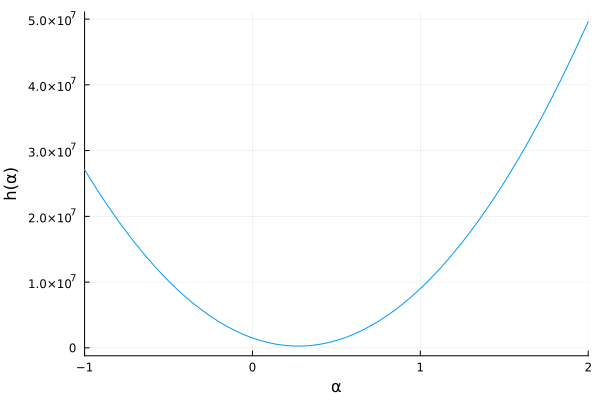
Apply MM-based line search: simple version. The key inputs are the gradient and curvature functions:
gradf = [
    u -> u - y, # ∇f₁ for data-fit term
    u -> β * dpot.(u), # ∇f₂ for regularizer
]
curvf = [
    1, # curvature for data-fit term
    u -> β * wpot.(u), # Huber curvature for regularizer
]

uu = [A * x, x] # [u₁ u₂]
vv = [A * d, d] # [v₁ v₂]
fun(state) = state.α # log this
ninner = 7
out = Vector{Any}(undef, ninner+1)
α0 = 0
αstar = line_search_mm(gradf, curvf, uu, vv; ninner, out, fun, α0)
hmin = h(αstar)
scatter!([αstar], [hmin], marker=:star, color=:red)
scatter!([α0], [h(α0)], marker=:circle, color=:green)
ps = plot(0:ninner, out, marker=:circle, xlabel="iteration", ylabel="α",
    color = :green)
pd = plot(0:ninner, abs.(dh.(out)), marker=:diamond,
    yaxis = :log, color=:red,
    xlabel="iteration", ylabel="|dh(α)|")
pu = plot(1:ninner, log10.(max.(abs.(diff(out)), 1e-16)), marker=:square,
    color=:blue, xlabel="iteration", ylabel="log10(|α_k - α_{k-1}|)")
plot(pa, ps, pd, pu)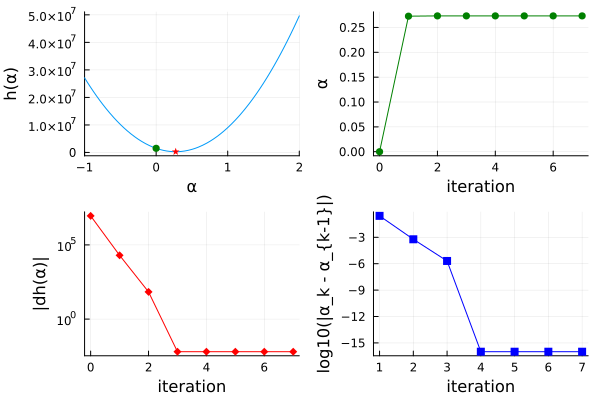
Thanks to Huber's curvatures, the $α_t$ sequence converges very quickly.
Now explore a fancier version that needs less heap memory.
work = LineSearchMMWork(uu, vv, α0) # pre-allocate
function lsmm1(gradf, curvf)
    return line_search_mm(gradf, curvf, uu, vv;
        ninner, out, fun, α0, work)
end
function lsmm2(dot_gradf, dot_curvf)
    gradn = [() -> nothing, () -> nothing]
    return line_search_mm(uu, vv, dot_gradf, dot_curvf;
        ninner, out, fun, α0, work)
end;
The let statements below are a performance trick from the Julia manual. Using Iterators.map avoids allocating arrays like z - y and does not even require any work space.
gradz = [
    let y=y; z -> Iterators.map(-, z, y); end, # z - y
    let β=β, dpot=dpot; z -> Iterators.map(z -> β * dpot(z), z); end, # β * dψ.(z)
]
curvz = [
    1,
    let β=β, wpot=wpot; z -> Iterators.map(z -> β * wpot(z), z); end, # β * ωψ.(z)
]

function make_grad1c()
    w = similar(uu[1]) # work-space
    let w=w, y=y
        function grad1c(z)
            @. w = z - y
            return w
        end
    end
end

function make_grad2c()
    w = similar(uu[2]) # work-space
    let w=w, β=β, dpot=dpot
        function grad2c(z)
            @. w = β * dpot(z)
            return w
        end
    end
end

function make_curv2c()
    w = similar(uu[2]) # work-space
    let w=w, β=β, wpot=wpot
        function curv2c(z)
            @. w = β * wpot(z) # β * ωψ.(z)
            return w
        end
    end
end

gradc = [ # capture version
    make_grad1c(), # z - y
    make_grad2c(), # β * dψ.(z)
]
curvc = [
    1,
    make_curv2c(), # β * ωψ.(z)
]

sum_map(f::Function, args...) = sum(Iterators.map(f, args...))
dot_gradz = [
    let y=y; (v,z) -> sum_map((v,z,y) -> dot(v, z - y), v, z, y); end, # v'(z - y)
    let β=β, dpot=dpot; (v,z) -> β * sum_map((v,z) -> dot(v, dpot(z)), v, z); end, # β * (v'dψ.(z))
]
dot_curvz = [
    (v,z) -> norm(v)^2,
    let β=β, wpot=wpot; (v,z) -> β * sum_map((v,z) -> abs2(v) * wpot(z), v, z); end, # β * (abs2.(v)'ωψ.(z))
]


a1 = lsmm1(gradf, curvf)
a1c = lsmm1(gradc, curvc)
a2 = lsmm1(gradz, curvz)
a3 = lsmm2(dot_gradz, dot_curvz)
@assert a1 ≈ a2 ≈ a3 ≈ a1c

b1 = @benchmark a1 = lsmm1($gradf, $curvf)
BenchmarkTools.Trial: 10000 samples with 1 evaluation per sample.
Range (min … max): 121.254 μs … 6.156 ms ┊ GC (min … max): 0.00% … 95.16%
Time (median): 129.616 μs ┊ GC (median): 0.00%
Time (mean ± σ): 150.007 μs ± 155.187 μs ┊ GC (mean ± σ): 11.45% ± 10.66%
█▅▂ ▁
███▇▅▃▃▁▁▁▁▁▁▁▁▁▁▁▁▁▁▁▁▁▁▁▁▁▁▁▁▁▁▁▁▁▁▁▁▁▁▁▁▁▁▁▁▁▁▃▄▁▄▅▅▅▆▅▆▅▆ █
121 μs Histogram: log(frequency) by time 1.07 ms <
Memory estimate: 499.93 KiB, allocs estimate: 310.bc = @benchmark a1c = lsmm1($gradc, $curvc)BenchmarkTools.Trial: 10000 samples with 1 evaluation per sample.
Range (min … max): 99.351 μs … 330.771 μs ┊ GC (min … max): 0.00% … 0.00%
Time (median): 100.492 μs ┊ GC (median): 0.00%
Time (mean ± σ): 102.063 μs ± 7.342 μs ┊ GC (mean ± σ): 0.00% ± 0.00%
▃▇█▇▅▄▃▃▂▂ ▁▁ ▁▃▃▃▂▁▁ ▂
██████████████▇▆▆▆██████████▇▆▇▆▆▅▆▄▅▅▅▅▄▄▃▄▃▄▅▁▄▄▁▁▃▄▄▄▅▄▅▄▄ █
99.4 μs Histogram: log(frequency) by time 123 μs <
Memory estimate: 4.62 KiB, allocs estimate: 180.b2 = @benchmark a2 = lsmm1($gradz, $curvz)BenchmarkTools.Trial: 10000 samples with 1 evaluation per sample.
Range (min … max): 143.647 μs … 276.008 μs ┊ GC (min … max): 0.00% … 0.00%
Time (median): 146.872 μs ┊ GC (median): 0.00%
Time (mean ± σ): 148.442 μs ± 4.959 μs ┊ GC (mean ± σ): 0.00% ± 0.00%
▄██▆▂
▁▁▁▂▄▇█████▇▅▅▅▄▄▃▃▂▂▂▂▂▁▂▂▂▃▃▃▃▂▂▂▂▂▂▂▁▁▁▁▁▁▁▁▁▁▁▁▁▁▁▁▁▁▁▁▁▁ ▂
144 μs Histogram: frequency by time 163 μs <
Memory estimate: 4.58 KiB, allocs estimate: 180.b3 = @benchmark a3 = lsmm2($dot_gradz, $dot_curvz)BenchmarkTools.Trial: 10000 samples with 1 evaluation per sample.
Range (min … max): 93.172 μs … 203.328 μs ┊ GC (min … max): 0.00% … 0.00%
Time (median): 95.644 μs ┊ GC (median): 0.00%
Time (mean ± σ): 96.712 μs ± 3.110 μs ┊ GC (mean ± σ): 0.00% ± 0.00%
█▄█▃ ▁
▁▁▁▂▃▄▇▇████▅▃▃▃▅▆███▇▄▃▂▂▁▁▁▁▁▁▁▁▁▁▁▁▂▂▂▂▂▂▂▂▂▂▁▂▂▂▂▂▁▁▁▁▁▁ ▂
93.2 μs Histogram: frequency by time 105 μs <
Memory estimate: 2.03 KiB, allocs estimate: 110.Timing results on my Mac:
- 95 μs
- 65 μs # 1c after using
make_ - 80 μs
- 69 μs (and lowest memory)
The versions using gradc and dot_gradz with their "properly captured" variables are the fastest. But all the versions here are pretty similar so even using the simplest version seems likely to be fine.
Compare with LineSearches.jl
Was all this specialized effort useful? Let's compare to the general line search methods in LineSearches.jl.
It seems that some of those methods do not allow $α₀ = 0$ so we use 1.0 instead. We use the default arguments for all the solvers, which means some of them might terminate before ninner iterations, giving them a potential speed advantage.
a0 = 1.0 # α0
hdh(α) = h(α), dh(α)
h0 = h(0)
dh0 = dh(0);
function ls_ls(linesearch)
    a1, fx = linesearch(h, dh, hdh, a0, h0, dh0)
    return a1
end;

solvers = [
    BackTracking( ; iterations = ninner),
    HagerZhang( ; linesearchmax = ninner),
    MoreThuente( ; maxfev = ninner),
]
for ls in solvers # check that they work properly
    als = ls_ls(ls)
    @assert isapprox(als, αstar; atol=1e-3)
end;
bbt = @benchmark ls_ls($(solvers[1]))BenchmarkTools.Trial: 10000 samples with 1 evaluation per sample.
Range (min … max): 295.949 μs … 2.167 ms ┊ GC (min … max): 0.00% … 66.48%
Time (median): 316.600 μs ┊ GC (median): 0.00%
Time (mean ± σ): 329.109 μs ± 122.960 μs ┊ GC (mean ± σ): 2.45% ± 5.48%
▂▃▇███▆▅▄▃▃▃▂▂▁
▁▁▁▂▄▇████████████████▇▇▆▅▅▅▄▃▃▃▃▃▂▂▂▂▂▂▂▂▂▂▁▁▁▁▁▁▁▁▁▁▁▁▁▁▁▁▁ ▃
296 μs Histogram: frequency by time 380 μs <
Memory estimate: 95.27 KiB, allocs estimate: 78.bhz = @benchmark ls_ls($(solvers[2]))BenchmarkTools.Trial: 5726 samples with 1 evaluation per sample.
Range (min … max): 798.639 μs … 2.632 ms ┊ GC (min … max): 0.00% … 48.37%
Time (median): 837.133 μs ┊ GC (median): 0.00%
Time (mean ± σ): 872.588 μs ± 206.088 μs ┊ GC (mean ± σ): 2.83% ± 7.52%
▆█▆▅▃▂ ▁
███████▅▅▄▃▄▄▄▁▁▁▁▁▁▁▁▁▁▁▁▁▁▁▁▁▁▁▁▁▁▁▁▁▁▁▁▁▁▁▁▁▁▁▁▁▁▁▁▄▅▆▇▇▆▆ █
799 μs Histogram: log(frequency) by time 2.26 ms <
Memory estimate: 315.47 KiB, allocs estimate: 124.bmt = @benchmark ls_ls($(solvers[3]))BenchmarkTools.Trial: 3795 samples with 1 evaluation per sample.
Range (min … max): 1.207 ms … 3.297 ms ┊ GC (min … max): 0.00% … 44.08%
Time (median): 1.263 ms ┊ GC (median): 0.00%
Time (mean ± σ): 1.317 ms ± 256.555 μs ┊ GC (mean ± σ): 2.85% ± 7.76%
▅█▇▅▄▄▃▁ ▁
████████▇▅▄▃▁▃▃▁▁▁▁▁▁▁▁▁▁▁▁▁▁▁▁▁▁▁▁▁▁▁▃▁▁▁▁▁▁▁▁▁▃▃▄▇▇▆▇▆▇▆▅ █
1.21 ms Histogram: log(frequency) by time 2.78 ms <
Memory estimate: 473.14 KiB, allocs estimate: 210.On my Mac the timings are all much longer compared to line_search_mm:
- 840 μs
BackTracking - 2.6 ms
HagerZhang - 3.9 ms
MoreThuente
This comparison illustrates the benefit of the "special purpose" line search.
The fastest version seems to be BackTracking, so plot its iterates:
alpha_bt = zeros(ninner + 1)
alpha_bt[1] = a0
for iter in 1:ninner
    tmp = BackTracking( ; iterations = iter)
    alpha_bt[iter+1] = ls_ls(tmp)
end
plot(0:ninner, alpha_bt, marker=:square, color=:blue,
    xlabel="Iteration", ylabel="BackTracking α")
plot!([0, ninner], [1,1] * αstar, color=:red)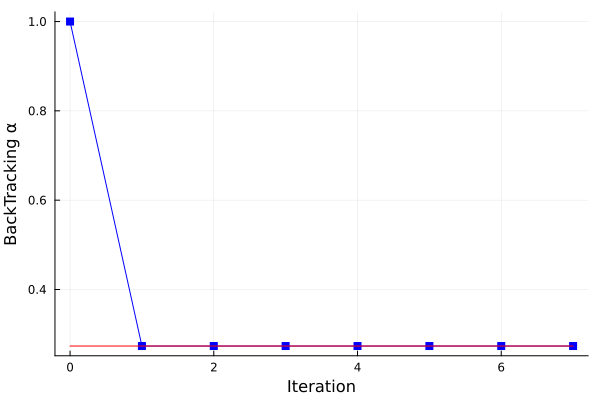
Unexpectedly, BackTracking seems to terminate at the first iteration. But even just that single iteration is slower than 7 iterations of line_search_mm.
prompt()Reproducibility
This page was generated with the following version of Julia:
using InteractiveUtils: versioninfo
io = IOBuffer(); versioninfo(io); split(String(take!(io)), '\n')
12-element Vector{SubString{String}}:
"Julia Version 1.12.6"
"Commit 15346901f00 (2026-04-09 19:20 UTC)"
"Build Info:"
" Official https://julialang.org release"
"Platform Info:"
" OS: Linux (x86_64-linux-gnu)"
" CPU: 4 × AMD EPYC 9V74 80-Core Processor"
" WORD_SIZE: 64"
" LLVM: libLLVM-18.1.7 (ORCJIT, znver4)"
" GC: Built with stock GC"
"Threads: 1 default, 1 interactive, 1 GC (on 4 virtual cores)"
""And with the following package versions
import Pkg; Pkg.status()Status `~/work/MIRT.jl/MIRT.jl/docs/Project.toml`
[6e4b80f9] BenchmarkTools v1.8.0
[e30172f5] Documenter v1.17.0
[d3d80556] LineSearches v7.7.1
[98b081ad] Literate v2.21.0
[7035ae7a] MIRT v0.18.3 `.`
[170b2178] MIRTjim v0.26.0
[91a5bcdd] Plots v1.41.6
[b77e0a4c] InteractiveUtils v1.11.0
[9a3f8284] Random v1.11.0This page was generated using Literate.jl.